




When I first started going deeper into spirituality, I also became more politically aware. I was paying attention to power, inequality, corruption, division, and all the ways society seemed to operate from fear and self-interest.
And I was angry.
My mindset was basically:
We have to change this. We have to do something.
At that point, I thought political participation was the way to create change.
Then my perspective shifted.
The more I watched, the more discouraged I became. Politics felt increasingly divided, manipulated, and deeply influenced by money, corporations, media, power, and special interests.
Eventually, I swung completely in the other direction.
I wanted out.
If the system was corrupt, why keep feeding it?
If politics was designed to divide people, why give it my energy?
If humanity was going through something much bigger spiritually, maybe I needed to stop focusing on the “matrix” altogether.
For a while, that made sense to me.
But now I've reached another place.
A more uncomfortable one.
If I do nothing, am I also participating in the problem?
That question changed something for me.
Because the truth is, most of us haven't actually escaped the system.
We may say, “I don't participate in the matrix,” but we still live inside societies shaped by laws, economics, healthcare, taxes, property rules, education, technology, infrastructure, and government decisions.
If I buy something as small as a pack of gum, I'm participating in an economic system.
If I pay taxes, I'm participating.
If I drive on public roads, own a business, use a bank, pay utilities, rent or buy a home, or use healthcare, I am interacting with the very system I may claim to have stepped away from.
So maybe the question isn't:
“How do I escape the matrix?”
Maybe it's:
“How do I remain conscious while living inside it?”
When Spirituality Becomes an Escape
Within spiritual communities, I sometimes hear things like:
“It's all happening exactly as it's supposed to.”
“Politics is just division.”
“Everything is already planned.”
“I don't give my energy to the system.”
And I understand where those perspectives come from.
There may even be truth in some of them.
But I've also started wondering whether spiritual language can sometimes become a way of avoiding uncomfortable human responsibility.
That's where spiritual bypassing can sneak in.
We can become so focused on rising above the world that we forget we came here to live inside the human experience too.
We can talk about compassion while ignoring policies that affect real people.
We can talk about unity consciousness while refusing to engage with systems that shape millions of lives.
We can talk about service to others while deciding anything political is beneath our spiritual attention.
I don't think spirituality was ever supposed to make us indifferent.
Maybe awareness should make us more conscious of our impact, not less.
But I Still Struggle With Politics
One of my biggest frustrations is constantly hearing:
“You have to choose the lesser of two evils.”
But what happens when I don't believe in either candidate?
What happens when neither represents my values?
Why should participating require me to endorse someone I genuinely don't support?
And then comes the other side.
If I refuse to participate because I don't like any of the choices, am I exercising my sovereignty?
Or am I simply giving my influence away?
I'm still torn about that.
And I don't want to pretend I have a neat spiritual answer.
I don't believe the message should be:
“Everyone must vote no matter what.”
But I also don't believe the answer is:
“The system is corrupt, so nothing matters.”
Maybe both of those positions are too simple.
Civic participation can mean more than supporting a presidential candidate.
It can mean paying attention to local elections, supporting policies, contacting representatives, helping communities, attending meetings, organizing, volunteering, building alternatives, or supporting people whose values genuinely reflect our own.
Voting is one form of participation.
It isn't the only one.
What If Heart-Centered People Are Exactly Who Should Be Involved?
For a while, I thought conscious people should separate themselves from corrupted systems.
Now I find myself asking:
If compassionate, spiritually grounded people completely abandon those spaces, who remains to shape them?
Maybe the answer to corruption isn't fewer heart-centered people participating.
Maybe we need more.
People who can disagree without dehumanizing.
People who understand sovereignty and responsibility.
People who care about humanity beyond political parties.
People who can question authority without becoming consumed by conspiracy.
People who can recognize corruption without surrendering to cynicism.
People who can enter difficult spaces without becoming the very thing they hoped to change.
That, to me, can also be spiritual practice.
Not escaping the world.
Bringing consciousness into it.
Detachment Is Not Disengagement
I still believe there is wisdom in stepping away from political outrage.
Not every headline deserves our energy.
Political parties should not become our identities.
Politicians should not become our saviors.
Protecting our peace matters.
But protecting our peace and abandoning responsibility are not always the same thing.
We can detach from hatred while remaining engaged.
We can reject division while still having convictions.
We can challenge harmful systems without dehumanizing the people inside them.
We can participate without worshipping the system.
Maybe that's where I'm landing now.
Not blind participation.
Not complete withdrawal.
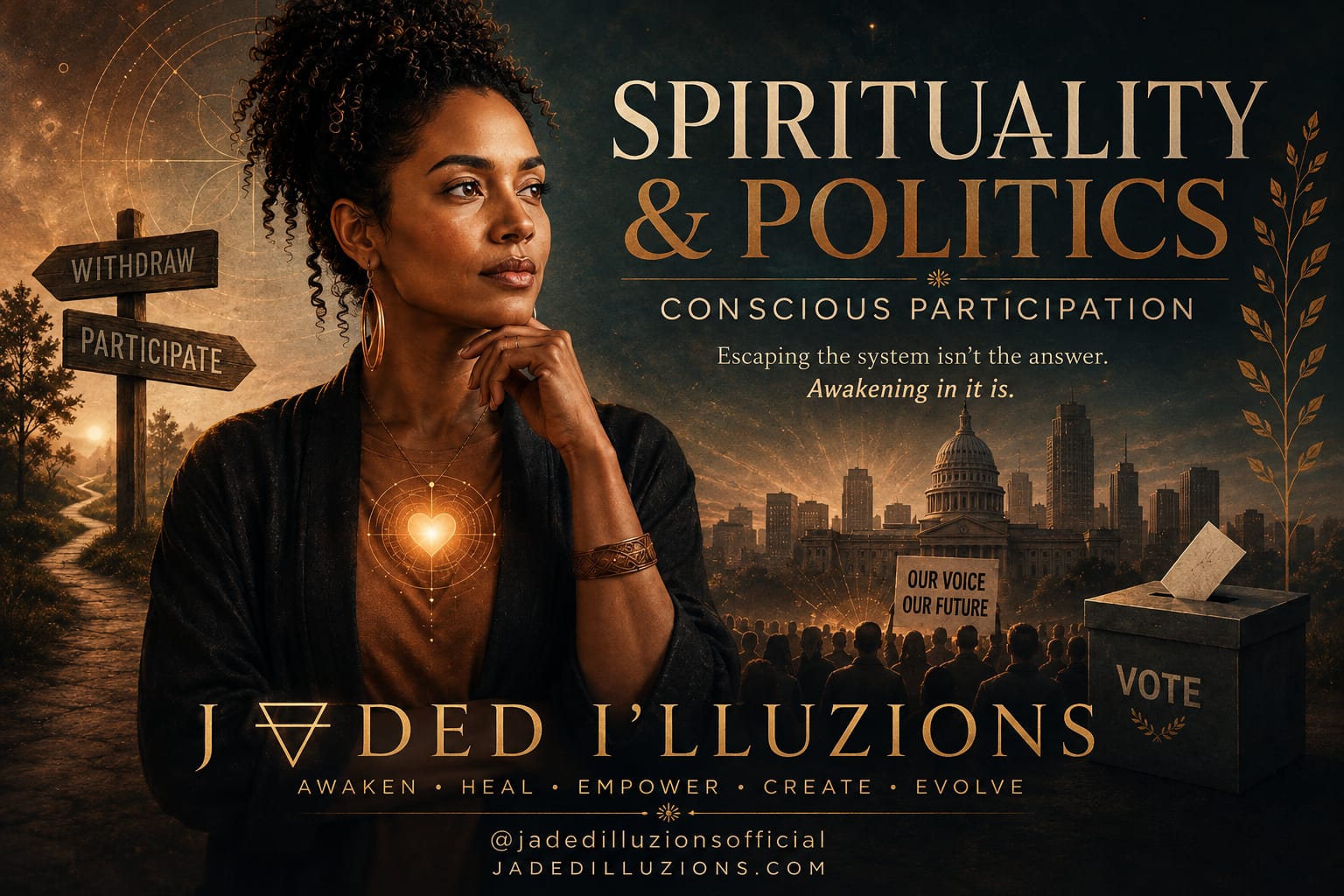
But conscious participation.
Maybe awakening isn't about escaping society.
Maybe it's about seeing society more clearly and deciding how we want to show up within it.
Because if humanity truly is interconnected, then governments, economies, communities, and institutions aren't separate from human consciousness.
They are expressions of it.
Sometimes evolution happens in meditation.
Sometimes it happens in healing circles.
Sometimes it happens through advocacy.
Sometimes it happens at the ballot box.
Sometimes it happens by building something better than the system we're criticizing.
And sometimes it begins by simply refusing to look away.
I'm still figuring out what my own participation will look like.
But I am beginning to understand this:
Doing nothing is still a choice.
And if I believe humanity is capable of becoming more compassionate, conscious, and unified, then perhaps my responsibility isn't to escape the world because it hasn't reached that consciousness yet.
Perhaps the deeper question is:
How can I bring more consciousness into the part of the world I can actually touch?
For where I am on my journey right now, that feels closer to service to others.
